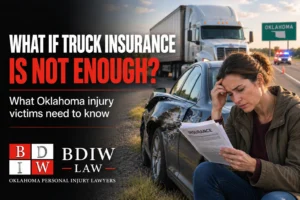
An insurance limit does not necessarily end an Oklahoma truck accident claim. Other policies, other legally responsible parties, and your own uninsured or underinsured motorist coverage may provide additional options, depending on the facts and policy terms. Before accepting a limits offer, have the available coverage, full damages, and release language reviewed together.
A serious truck crash can turn an ordinary week into a financial problem your family never expected. There may be surgery, missed work, a damaged vehicle, and months of uncertainty. Then an adjuster says the insurance is almost exhausted. That is the point to ask better questions before making a permanent decision.
BDIW Law’s Tulsa truck accident lawyers help injured people evaluate liability and potential recovery. The same coverage questions can arise after crashes near Ponca City, Stillwater, Oklahoma City, and elsewhere in Oklahoma.
What does a truck insurance limit actually tell you?
A policy limit describes the maximum available under a particular coverage, subject to the contract and applicable law. It does not tell you how much treatment you will need or how much income you will lose. An adjuster’s statement about one policy also leaves open whether another applicable policy exists.
Ask which insured person or company the offer concerns, which policy period applies, and whether the stated limit is shared across the collision. Request documentation through the appropriate process. A certificate of insurance can help identify an insurer, but the actual policy and endorsements need review.
The federal financial responsibility schedule in 49 CFR 387.9 includes a $750,000 minimum for certain for-hire interstate carriers transporting nonhazardous property in vehicles rated at 10,001 pounds or more. Different operations and cargo can trigger different requirements. That figure is not a promise that every truck crash provides that amount to each injured person.
Our Team Is Here To Assist You Every Step Of The Way.
SPEAK TO AN ATTORNEY TODAYWhere might additional coverage come from?
Start with the trucking operation itself. A driver, vehicle owner, motor carrier, and trailer owner may be different entities. Contracts, employment relationships, leases, and the actual work being performed help determine whose conduct and coverage deserve investigation. A company’s involvement alone does not establish liability.
There may also be excess or umbrella coverage above a primary policy. Those policies have their own attachment requirements, exclusions, and notice provisions. The goal is to identify a supported path to coverage rather than simply collect company names from the truck.
| Possible source | Question to investigate |
|---|---|
| Motor carrier coverage | Which business operated the trip, and which vehicles and drivers are covered? |
| Excess or umbrella policy | When does the additional layer apply, and what conditions must be met? |
| Another responsible party | Did separate negligent conduct contribute to the collision? |
| Your UM coverage | Does an applicable policy provide uninsured or underinsured motorist benefits? |
Can your own Oklahoma auto insurance help?
Possibly. The Oklahoma Insurance Department’s auto insurance FAQs explain that uninsured motorist coverage can address bodily injuries caused by uninsured or underinsured drivers, subject to coverage. Check policies that may cover you through your vehicle or household. Do not assume the truck’s commercial status automatically rules out this review.
Tell your lawyer about every potentially relevant policy, including policies you think are unrelated. Bring declarations pages, rejection forms if available, and correspondence. Whether you qualify as an insured and what benefits remain available require a policy-specific analysis.
Before releasing another driver or company, ask how that release could affect your own insurer’s rights and your coverage claim. Notice and settlement requirements matter. Accepting a check without reviewing the documents can create a problem that could have been addressed earlier.

What changes when several people are injured?
Multiple injury claims may compete for coverage arising from the same crash. The relevant limits and policy language need to be confirmed. The amount discussed with one family may not be an amount reserved exclusively for that family.
A hypothetical collision involving a truck and three passenger vehicles shows the issue. One person needs emergency surgery, another faces a long rehabilitation, and a third misses several weeks of work. The review must consider available coverage, all supported claims, and the proposed allocation. There is no universal rule that the first person who calls receives the entire policy.
Tell counsel about any request to sign an allocation agreement, attend a settlement conference, or respond to a court filing concerning insurance proceeds. Those documents deserve timely attention.
Why should damages be documented before a limits settlement?
A large offer can still leave a family with an unfunded care problem. Obtain a clear picture of treatment already provided, reasonable future care needs, work restrictions, and the effect on daily life. Medical professionals should explain expected treatment; a settlement discussion should not become a reason to guess about recovery.
Organize bills alongside payment records and insurance explanations. The billed total, an outstanding balance, and a reimbursement claim are different figures. BDIW’s explanation of medical bills and accident settlement proceeds provides useful background before discussing the amount you may actually receive.
Also preserve pay records, time away from work, assistance you needed at home, and specific limitations. An accurate account helps a lawyer assess an offer against the losses it is supposed to address.
What should you bring to a consultation?
Bring the crash report, photographs, insurer letters, policy information, treatment records, and any proposed release. If you only have a claim number and a few emails, start there. You do not need to finish the investigation before asking for help.
- Save original messages and attachments rather than edited screenshots alone.
- List the truck’s company name, vehicle number, and any carrier identification you recorded.
- Identify witnesses and nearby businesses that may have video.
- Keep a dated record of insurance offers and response deadlines.
- Explain whether anyone has already signed or accepted a settlement.
Truck records and outside video may not remain available indefinitely. Ask about preservation early, especially when the insurer is pushing for a quick resolution.
Frequently asked questions
Does a policy-limits offer mean the insurer admits fault?
Not necessarily. The offer, accompanying letter, and release determine what is being proposed. Have the documents reviewed rather than inferring an admission from the amount.
Is every Oklahoma truck required to carry $750,000?
No. Federal requirements depend on factors including the operation, vehicle rating, cargo, and applicable rules. The carrier’s actual coverage may also exceed a required minimum.
Can I automatically sue the truck broker?
No. A broker’s involvement does not automatically establish a viable claim. Liability, available legal theories, and defenses require a separate review.
Does UM coverage pay to repair my car?
Oklahoma UM coverage addresses bodily injury. Vehicle repair coverage is a separate question under the applicable auto policy.
Should I cash the check while deciding what to do?
Have the check and accompanying terms reviewed first. Payment documents can carry settlement conditions, and a signed release can affect important rights.
Can a lawyer guarantee recovery beyond the truck’s insurance?
No. Additional recovery depends on evidence, liability, available policies, assets, and other case-specific factors. A careful investigation can identify options without promising a result.
Get the coverage questions answered before signing
If a trucking insurer says there is not enough coverage for your injuries, request a free consultation with BDIW Law. Bring the offer and the paperwork. A clear explanation of your options is more useful than pressure to decide before you understand what the settlement would close.
General legal information. Available claims and coverage depend on the facts, policy terms, and applicable law.