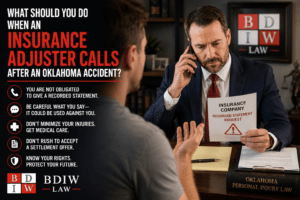
After an accident in Oklahoma, you may receive a phone call from an insurance adjuster sooner than you expect. The adjuster may sound friendly, concerned, and eager to get your side of the story. You may be asked how the accident happened, whether you are injured, where you received medical treatment, and whether you are willing to provide a recorded statement. What seems like a routine conversation can become an important part of your personal injury claim.
Insurance adjusters have a legitimate role in investigating claims, but they work for insurance companies rather than injured claimants. What you say during an early conversation may affect how the insurer evaluates fault, your injuries, and the amount it is willing to pay. If you were injured because of another person’s negligence, understanding how to handle insurance communications can help you avoid mistakes before you know the full extent of your losses.
Why Is the Insurance Adjuster Calling You?
An insurance company needs information to investigate an accident and determine whether its policy provides coverage. The adjuster may want basic information about when and where the accident happened, which vehicles or people were involved, and what damage occurred. In an Oklahoma personal injury claim, however, the adjuster may also be evaluating potential defenses against your case.
That distinction matters. Statements about how fast you were traveling, when you first noticed another vehicle, whether you could have avoided the collision, or how badly you were initially hurt may later become disputed issues. Oklahoma uses comparative negligence principles, so allegations that an injured person contributed to an accident can have significant consequences. An adjuster’s questions about fault therefore deserve careful consideration.
Our Team Is Here To Assist You Every Step Of The Way.
SPEAK TO AN ATTORNEY TODAYDo You Have to Give the Other Driver’s Insurance Company a Recorded Statement?
One of the first questions injured people often face is whether they should provide a recorded statement to the other party’s insurance company. BDIW Law specifically cautions accident victims about this issue in its guidance on recorded statements to insurance companies. The firm’s guidance explains that an insurance adjuster represents the insurance company’s interests and that statements may be used in evaluating or challenging a personal injury claim. (BDIW Law)
Do not confuse an obligation you may have under your own insurance policy with a request from another person’s insurer. Different policies and circumstances can create different responsibilities, so broad rules should not be assumed without reviewing the situation. If another driver’s adjuster asks you to provide a recorded interview following a serious accident, consider speaking with an Oklahoma personal injury lawyer before agreeing to it.
Be Careful When Discussing How the Accident Happened
Immediately after an accident, you may not know exactly what happened. Collisions occur quickly, and your perspective may have been limited. Additional evidence such as traffic cameras, dashcams, witness accounts, photographs, vehicle data, and police reports may eventually provide information you did not have at the scene.
This is why speculation can be dangerous. Saying “I guess I didn’t see him” or “maybe I could have stopped sooner” can sound very different when repeated during an insurance dispute. Stick to facts you actually know rather than guessing about speed, distance, timing, or fault.
Oklahoma’s comparative negligence statute makes accurate fault determinations particularly important. Under Oklahoma’s comparative negligence law, contributory negligence does not bar recovery when the injured person’s negligence is not greater than the combined negligence of the person or persons causing the damage, although damages are reduced in proportion to the injured person’s negligence. That makes unsupported admissions about responsibility potentially significant in a disputed claim.
Do Not Minimize Your Injuries
Another common question from an adjuster is simple: “How are you feeling?” In normal conversation, many people instinctively answer, “I’m fine,” “I’m okay,” or “not too bad.” After an accident, those casual responses may not accurately reflect what is happening medically.
Some injuries become more apparent after the initial shock of an accident subsides. BDIW has addressed this problem in its existing discussion of delayed symptoms and hidden accident injuries. If you do not yet know the extent of your injuries, you do not need to speculate about your prognosis.
Instead, focus on getting appropriate medical attention and describing your symptoms accurately to your healthcare providers. Do not exaggerate your injuries, but do not minimize them either. Medical records created through legitimate treatment can become important evidence of the injuries and limitations associated with the accident.
Why Medical Treatment Matters to Your Personal Injury Claim
Insurance companies evaluate whether the injuries being claimed can be connected to the accident. If there is a long unexplained gap between an accident and medical treatment, an insurer may question whether the collision caused the condition. Prompt medical evaluation can protect your health while also creating contemporaneous documentation of your symptoms.
Follow-up treatment matters as well. If a doctor recommends physical therapy, diagnostic testing, specialist care, or another course of treatment, failing to follow medical advice without explanation may create questions about the severity of the injury. At the same time, treatment decisions should be made between you and qualified healthcare providers rather than for the purpose of increasing a legal claim.
Medical bills can also become more complicated than many accident victims expect. Health insurers, medical providers, Medicare, Medicaid, or other entities may have reimbursement or lien rights in some circumstances. BDIW discusses these issues in its explanation of how medical bills can affect a car accident settlement. (BDIW Law)
Be Cautious About Signing Medical Authorizations
An insurance adjuster may ask you to sign an authorization allowing the company to obtain medical records. Medical documentation is obviously relevant to an injury claim, but you should understand what an authorization permits before signing it. A broadly worded authorization may potentially allow access to more medical history than you expected.
This becomes especially important when you have prior injuries or pre-existing conditions. The insurer may investigate whether you experienced similar symptoms before the accident. Prior medical history does not automatically eliminate an Oklahoma personal injury claim, but it can make the medical causation analysis more complicated.
Ask what records are being requested, why they are needed, and what period the authorization covers. If the claim involves significant injuries, surgery, substantial lost income, or a disputed pre-existing condition, consider obtaining legal advice before providing broad authorization for your medical history.
Do Not Rush to Accept an Early Settlement Offer
A quick settlement can sound attractive when medical bills are arriving and an injury has kept you away from work. An insurer may make an early offer before you have completed treatment or know whether your injuries will cause lasting problems. Accepting that offer may require signing a release resolving the claim.
That creates an obvious risk. If you later learn that you need surgery, extended rehabilitation, additional diagnostic testing, or substantial time away from work, you may discover that the original settlement did not account for those losses. A resolved claim generally cannot simply be renegotiated because the injuries turned out to be more serious than expected.
Before evaluating an offer, you should have a reasonable understanding of your medical condition and damages. These may include medical expenses, lost income, reduced earning ability, future treatment supported by medical evidence, pain and suffering, and other compensable losses depending on the case. BDIW’s Oklahoma personal injury attorneys can review the circumstances of a claim before an injured person decides whether an insurance offer adequately addresses those losses.
Keep Your Own Documentation After the Accident
Do not rely entirely on the insurance company to create the record of what happened. Keep copies of accident reports, photographs, correspondence, medical bills, repair estimates, receipts, and other relevant documents. Maintain records showing the time you missed from work and any significant accident-related expenses.
Photographs can be particularly valuable because conditions change. Vehicles are repaired, hazards disappear, bruises heal, and accident scenes are cleared. If you can safely photograph relevant evidence after an accident, those images may preserve information that becomes difficult to reconstruct later.
The same principle applies to communications with the insurance company. Save emails and letters and make notes about significant telephone conversations. Knowing what information was requested and what you provided can prevent confusion as the claim progresses.
What Information Can You Safely Give an Insurance Adjuster?
You do not need to be hostile or confrontational when an adjuster calls. Basic identifying information and factual details may be appropriate depending on the circumstances. The important distinction is between providing straightforward information and offering unnecessary opinions about liability, medical causation, or the value of your case.
Do not guess. Do not exaggerate. Do not agree with a version of the accident simply because the adjuster suggests it during a question.
If you do not know an answer, saying that you do not know is more accurate than filling in missing details. If you are uncomfortable answering questions or the accident resulted in significant injuries, you can tell the adjuster that you want to obtain legal advice before discussing the claim further.
How an Oklahoma Personal Injury Lawyer Can Handle Insurance Communications
One benefit of legal representation is that your attorney can communicate with the insurance companies involved in the claim. This reduces the risk that an injured person will be pressured into answering complicated questions while recovering from an accident. It also allows the lawyer to organize the evidence and present the claim based on medical records, liability evidence, and documented financial losses.
An attorney can also investigate issues that may not be obvious immediately after the accident. Depending on the case, this could include obtaining surveillance footage, interviewing witnesses, reviewing insurance coverage, examining commercial vehicle records, or identifying additional parties who may be responsible.
For someone injured in a motor vehicle collision, BDIW’s Oklahoma car accident lawyers provide another relevant resource for understanding the claims process and potential compensation following a crash.
Know Who the Insurance Adjuster Represents
Perhaps the most important point is also the simplest: the adjuster for the other party’s insurance company does not represent you. That does not mean every conversation with an adjuster is improper or adversarial. It means you should understand the business relationship before discussing a potentially valuable personal injury claim.
The Oklahoma Insurance Department provides consumer information about automobile insurance and insurance-related issues through its official Oklahoma auto insurance resources. Consumers can use the agency’s materials to better understand insurance coverage and the regulatory role of the state. The National Association of Insurance Commissioners consumer insurance resources also provide independent information about insurance policies, claims, and consumer protections.
If you suffered a serious injury, the period immediately after the accident is not the time to make assumptions about fault, long-term medical needs, or settlement value. Obtain medical care, preserve evidence, document your losses, and understand your legal rights before making decisions that could permanently resolve the claim.
Frequently Asked Questions About Insurance Adjusters After an Oklahoma Accident
Should I talk to the other driver’s insurance adjuster after an Oklahoma car accident?
You may receive a request for information, but you should be cautious about detailed or recorded statements, particularly when you are injured or liability is disputed. Consider obtaining legal advice before giving a recorded statement to another party’s insurer.
Can an insurance adjuster use my recorded statement against my claim?
Statements made during the claims process may become relevant when the insurer evaluates liability, causation, and damages. BDIW specifically warns that recorded statements can potentially be used to challenge a personal injury claim. (BDIW Law)
Should I accept the insurance company’s first settlement offer?
You should understand the extent of your injuries and losses before resolving a claim. An early offer made before treatment is complete may not account for future medical care, additional lost income, or lasting limitations.
Can the insurance company request my medical records?
Medical records relevant to your claimed injuries may be important to evaluating the case. However, you should understand the scope of any medical authorization before signing it, particularly if it provides broad access to prior medical history.
When should I contact an Oklahoma personal injury lawyer?
Consider speaking with a lawyer when an accident causes significant injuries, substantial medical treatment, missed work, disputed liability, a pre-existing-condition dispute, or pressure to provide statements or accept a settlement. Getting advice before signing releases or resolving the claim can help you understand the consequences of those decisions.