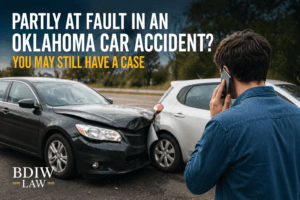
After a crash, many injured drivers worry that one bad decision or one allegation from an insurance adjuster means the case is over. That is usually not true. In Oklahoma, fault disputes are common in intersection collisions, rear-end crashes, lane-change wrecks, and weather-related accidents. A person can still have a valid claim even when the other side argues that the injured driver contributed to the collision. What matters is how fault is assigned under Oklahoma law and whether the evidence actually supports the percentage the insurer is trying to place on you.
Oklahoma Uses Modified Comparative Negligence
Oklahoma follows a modified comparative negligence rule. In practical terms, that means an injured person can still recover damages so long as their negligence is not greater than the combined negligence of the other responsible party or parties. If fault is assigned to you, your compensation is reduced by that percentage instead of disappearing automatically. That rule is why shared-fault cases require careful analysis instead of quick assumptions. A small shift in percentage can materially change the settlement value of a car accident claim.
For readers who want background on how Oklahoma courts discuss negligence principles, the Oklahoma comparative negligence statute is a useful authority source. In a practical case evaluation, however, the focus is less about quoting the statute and more about building the facts that support the lowest possible fault assignment for the injured client.
How Insurance Companies Use Shared Fault to Reduce Payouts
Insurance companies understand comparative negligence very well, and they use it aggressively. An adjuster may say you were speeding, following too closely, failing to keep a proper lookout, changing lanes unsafely, or reacting too slowly. Sometimes those arguments are backed by evidence. Other times, they are negotiation tactics designed to push down the value of a claim. In serious injury cases, insurers know that if they can move fault even modestly, they can save a meaningful amount of money. That is why statements given too early can create problems long before the full evidence is available.
Common Scenarios Where Partial Fault Is Alleged
Shared-fault arguments show up in many ordinary crashes. In an intersection collision, the other side may claim one driver ran a light while the other entered too quickly. In a rear-end wreck, the defense may point to a sudden stop or allegedly defective brake lights. In a sideswipe case, both drivers may blame one another for drifting or failing to signal. Even in a distracted driving case, the insurer may try to argue that the injured person still had time to avoid the crash. Oklahoma safety guidance on distracted driving reinforces how closely driver attention can matter in accident investigations.
For a reliable safety reference, see the Oklahoma distracted driving guidance, which explains why driver attention is treated as such an important issue in crash prevention and accident review.
The Evidence That Helps Protect Your Claim
In a comparative negligence case, proof matters more than opinion. The strongest evidence often includes scene photographs, vehicle damage, witness statements, traffic camera footage, dashcam video, police reports, black box or event data when available, and cell phone evidence when distraction is a serious issue. Prompt medical treatment also matters because it links the crash to your injuries and makes it harder for the insurer to argue that the symptoms came from somewhere else. BDIW has already emphasized on its site that evidence preservation can significantly affect the value and strength of a motor vehicle claim.
Readers can move from this article to BDIW’s discussion of preserving evidence after a car accident and its guidance on how to obtain traffic video after an Oklahoma car accident for more issue-specific help.
Why Medical Documentation Matters So Much
Many injured people make the mistake of waiting to get checked out because they hope the pain will go away. That delay can give the insurer a built-in argument. Adjusters may claim the injury was minor, unrelated, or caused by something that happened later. That is especially risky in soft tissue, neck, back, and concussion-related cases where symptoms can worsen over the next day or two. Prompt evaluation, follow-up care, and consistent reporting of symptoms create a much more credible record than trying to explain a treatment gap after the fact.
Do Not Let a Recorded Statement Lock In a Bad Narrative
One of the easiest ways a partial-fault case gets damaged is through a casual recorded statement. People naturally try to be polite after a crash. They say things like “I’m okay,” “I did not see them,” or “maybe I could have stopped sooner.” Those comments can be turned into admissions. Before the scene is fully documented and before you understand the injuries, broad statements about fault can be misleading. It is better to stick to the known facts, get medical attention, preserve evidence, and speak with counsel before allowing the insurer to frame the story in a way that favors the defense.
Someone who needs immediate help can continue to BDIW’s Oklahoma car accident lawyer page or the firm’s Oklahoma City car accident lawyer page to learn how the firm handles these claims across the state.
Sharing some fault does not automatically destroy a car accident claim in Oklahoma. The real question is whether the evidence supports the insurer’s story, whether your injuries are properly documented, and whether the other driver or another party still bears the larger share of responsibility. In a serious injury case, percentage points matter. That is why early evidence collection, careful medical documentation, and informed legal strategy can make such a meaningful difference.
Frequently Asked Questions
Can I still recover compensation if I was 10% or 20% at fault?
Yes. In Oklahoma, partial fault does not automatically end a claim. Instead, compensation is typically reduced by the percentage of fault assigned to the injured person.
Our Team Is Here To Assist You Every Step Of The Way.
SPEAK TO AN ATTORNEY TODAYWhat if the insurance company says I caused the accident too?
That means liability is disputed, not that the case is over. The key question is whether the evidence actually supports the fault percentage the insurer is asserting.
What evidence helps in a shared-fault accident case?
Photos, dashcam footage, witness statements, police reports, scene evidence, traffic video, and prompt medical records can all help protect the claim.
Where can I learn more from BDIW?
You can review the firm’s car accident attorney resources and its article on preserving crash evidence.
What authority sources are worth reading?
The Oklahoma comparative negligence statute and the Oklahoma distracted driving guidance are both useful starting points.